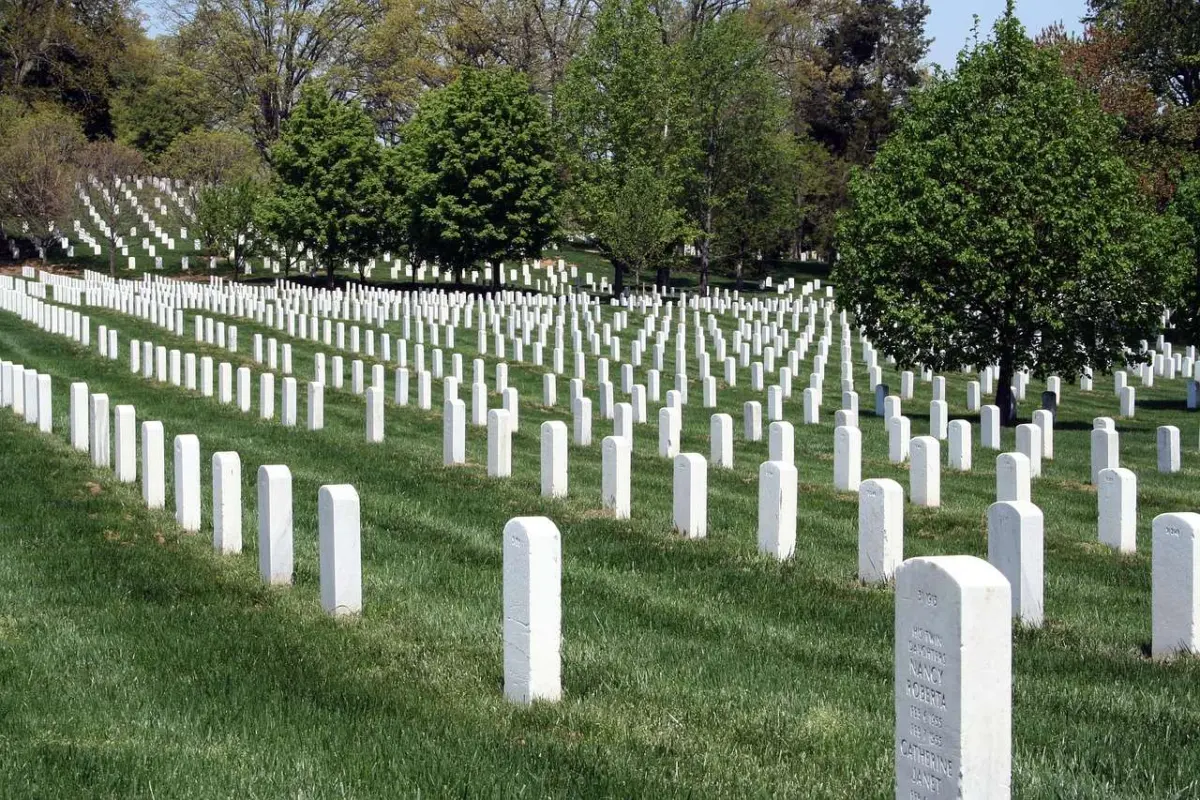
Wondering how Robert E. Lee’s Virginia estate became a national burial ground? Arlington national cemetery history begins in 1864, when the Union Army, short of burial space for Civil War dead, set aside part of the estate.
This guide belongs to the military and veterans section of the site, which looks at service and its legacy.
| Item | Value |
|---|---|
| Army began burying soldiers on the estate | May 1864 |
| Secretary of War Stanton approved the cemetery site | June 15, 1864 (not exceeding 200 acres) |
| Bodies buried beside the rose garden | 26 (August 1864) |
| Unknown Civil War dead sealed in the 1866 tomb | 2,111 soldiers |
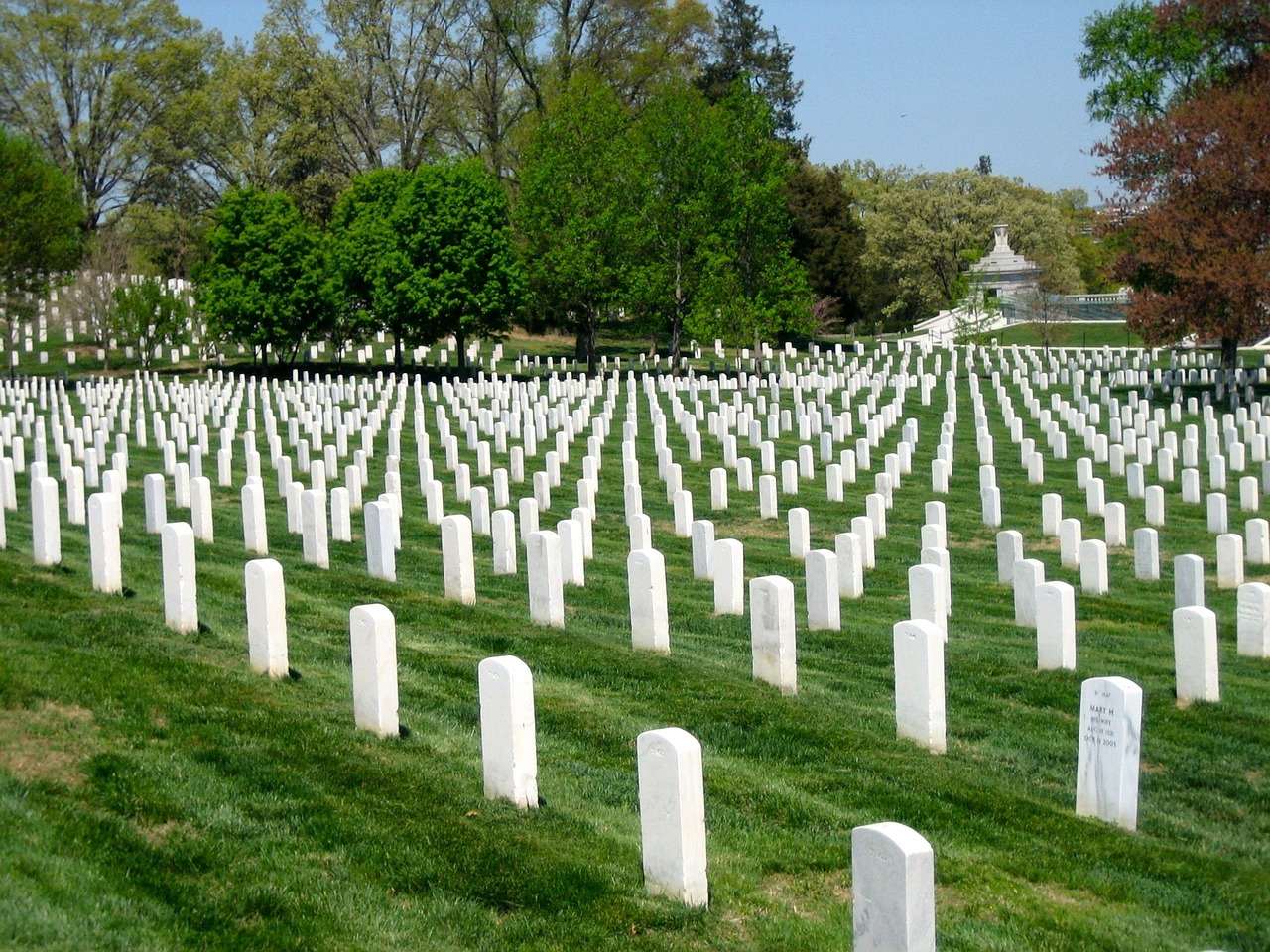
| Size of the cemetery today, per the Cultural Landscape Foundation | 624 acres |
| Interments, per the Cultural Landscape Foundation | Over 300,000 |
These figures come from the National Park Service and the Cultural Landscape Foundation. Figures can change, so check the source before you rely on them.
What was Arlington before it became a cemetery?
According to Encyclopedia Virginia, Arlington House was built between 1802 and 1818 under George Washington Parke Custis, grandson of Martha Washington. Enslaved laborers built the house, and the estate covered 1,100 acres.
Robert E. Lee married Mary Anna Randolph Custis at Arlington on June 30, 1831. On April 22, 1861, he made his decision to resign his U.S. Army commission there and side with Virginia, and his family departed the following month, as Encyclopedia Virginia records.
The grounds then took on a second life. Union officials chose them in May 1863 as the site of a Freedman’s Village, formally dedicated in December 1863. Residents resisted efforts to remove the community until 1900, according to the same entry.
How did the Army choose Arlington in 1864?
In the spring of 1864, Union forces under Lieutenant General U.S. Grant began a major offensive, and Washington hospitals filled with wounded soldiers. As many of the men died, local cemeteries filled to capacity, the National Park Service explains.
The Army started burying soldiers along the northern border of the Arlington estate in May 1864, approximately one half mile from the mansion-headquarters. The Army had occupied Arlington since 1861, and the U.S. Government had bought the property at public auction in January 1864.
Quartermaster General Montgomery Meigs formally proposed Arlington as the site in a letter to Secretary of War Stanton on June 15, 1864. Stanton approved it the same day and ordered that part of the estate, “not exceeding two hundred acres,” be surveyed and laid out. The NPS adds that the land’s link to Lee probably made it more attractive to Meigs, per the same NPS account.
Why Meigs wanted graves beside the mansion
Born in Augusta, Georgia, Montgomery Meigs was promoted to brigadier general and then quartermaster general of the Union army in 1861, as the Cultural Landscape Foundation notes. In 1864 he chose Arlington House’s grounds for the new cemetery and directed its original survey and layout.
Meigs doubted the cemetery was permanent. He feared the Lees might regain the property after the war and remove the graves, so he wanted burials as close to the mansion as possible to make it uninhabitable.
Officers living in the mansion pushed back, and the burial locations shifted in three stages:
- Burials began in the northeast corner of the grounds, near Arlington road.
- After Meigs gave orders to bury nearer the house, they were driven off to the western portion.
- In August 1864, after considerable effort, Meigs got his wish and 26 bodies were buried along the perimeter of Mrs. Lee’s rose garden.
The issue stayed alive. A December 1865 letter from one of Meigs’ assistants noted that more than a thousand interments were still to be made, so his wishes could now be carried out, according to the National Park Service. The letter also repeated a remark by Lee’s brother Smith Lee that the house could still be a pleasant residence if the cemetery were fenced off.
The 1866 tomb for unknown soldiers
To make a return of the Lee family even less likely, Meigs ordered a tomb for unknown Civil War dead built in the rose garden in April 1866. The remains of 2,111 unknown soldiers, recovered from battlefields near Washington, were sealed in the vault, the National Park Service reports.
They joined some 15,000 other Civil War fatalities. The Cultural Landscape Foundation likewise says the cemetery had over 15,000 burials by 1866.
Meigs later joined the ground he had created. He died in Washington, D.C., and was interred with military honors in Arlington National Cemetery, according to the Cultural Landscape Foundation.
How the Lee family lost Arlington for good
The Lee family lost ownership of the property during the war. A U.S. Supreme Court decision in U.S. v. Lee (1882) ruled that the house had been seized without due process, and a congressional act in 1883 authorized buying the property from George Washington Custis Lee for $150,000, per Encyclopedia Virginia.
The house itself followed a separate path:
- The War Department began restoring it in 1925.
- The National Park Service took over management in 1933.
- It was designated a memorial to Robert E. Lee in 1955.
- It was placed on the National Register of Historic Places in 1966.
Those dates come from the same Encyclopedia Virginia entry. The park service today also tells the story of the African Americans who lived and labored at Arlington in slavery and in freedom.
How the cemetery was redesigned
The Cultural Landscape Foundation says Frederick Law Olmsted Sr. advised a restrained, “studiously simple” design. Meigs instead laid out the cemetery to prevailing Victorian and Gilded Age standards.
Over about forty years, the result was a mix of disparate gravestones, memorials, monuments and arches. The McMillan Commission responded in its 1901-1902 plan by calling for uniformity and professional design oversight.
The plan also suggested a bridge connecting the Lincoln Memorial to Arlington House. McKim, Mead and White’s Neo-classical Memorial Bridge complex, symbolically linking North and South, gives the cemetery a grand entrance procession that ends in a hemicycle with Lee’s mansion high above it.
The same profile describes the cemetery as administered by the Department of the Army, covering 624 acres with over 300,000 interments. To see how the nation supported those who served in later conflicts, read the history of the gi bill. For the wider conflict that shaped so many later lives, the world war ii timeline is a useful companion.
Frequently asked questions
When did Arlington National Cemetery begin?
Show answer
The Army started burying soldiers on the estate in May 1864, and Secretary of War Stanton approved the cemetery site on June 15, 1864, according to the National Park Service.
Why was Arlington chosen for the cemetery?
Show answer
Cemeteries in and around Washington had filled with Civil War dead, and the Army had occupied Arlington since 1861. The government had also bought the property at auction in January 1864, and its connection to Lee probably added to its appeal, per the National Park Service.
Did the Lee family ever get Arlington back?
Show answer
No. A Supreme Court ruling in 1882 found the house had been seized without due process, but a congressional act in 1883 authorized the government to buy the property for $150,000, according to Encyclopedia Virginia.
How big is Arlington National Cemetery?
Show answer
The Cultural Landscape Foundation’s profile lists it at 624 acres with over 300,000 interments. Check the source for the latest wording, since such figures change.