Puzzled by sergeants, E-6s and who outranks whom? Military ranks explained in one line: grade is a level of authority, rank is the order of precedence, and enlisted personnel always rank below officers.
Ranks are one piece of the wider topic of military and veterans on this site.
| Item | Value |
|---|---|
| Enlisted personnel, cadets and midshipmen, share of the Armed Forces | About 82% |
| Officers, share of the Armed Forces | About 18% |
| Junior enlisted grades | E-1 to E-4, about 50% of the enlisted workforce |
| Mid-level NCO grades | E-5 to E-7 |
| Legal cap on E-8 and E-9 (share of a service’s enlisted members) | 3.0% and 1.25% |
| Active-duty enlisted personnel, September 30, 2025 | 1,049,509 |
These figures come from the Congressional Research Service’s enlisted personnel primer, updated January 7, 2026. Headcounts and rules can change, so check the source before you rely on them.
What grade, rank and pay grade mean
The Armed Forces are hierarchical organizations with clearly defined levels of authority. Those levels are called grades, while rank refers to the order of precedence among people in different grades and within the same grade.
That second part matters. Someone who has been a sergeant for three years outranks someone who has been a sergeant for two years, even though both hold the same grade.
A pay grade is an administrative classification that determines certain rates of pay. It is often used to indicate grade as well, so a staff sergeant in the Army may also be called an E-6. In everyday speech, most people use “rank” for all three ideas.
The service secretaries manage accession, promotion and assignments of enlisted members under broad statutory authorities. If you are curious how service later connects to education benefits, the history of the gi bill is a good next read.
The three tiers of the enlisted force
Enlisted personnel rank below all officers, and the enlisted force splits into three tiers:
- Junior enlisted (E-1 to E-4): these members typically work in small units and normally serve in these grades during their first enlistment term, usually four years. More senior enlisted personnel supervise them.
- Mid-level noncommissioned officers (E-5 to E-7): NCOs have significantly more responsibility. They lead small units of a few to several dozen personnel and act as technical experts in their occupational specialties.
- Senior noncommissioned officers (E-8 and E-9): they typically serve as senior enlisted advisors to commanders or as staff NCOs, and as a channel of support for the enlisted force in general.
Mid-level NCOs translate orders from their superior officers into action. That is the practical link between the officer who sets a plan and the junior members who carry it out.
Junior enlisted personnel make up about 50% of the enlisted workforce. By law, the authorized daily average of E-8 and E-9 personnel may not exceed 3.0% and 1.25%, respectively, of a service’s enlisted members on the first day of the fiscal year. The caps can be waived in certain circumstances.
Military ranks by the numbers: who sits at each pay grade
The pyramid is visible in the numbers. The table shows active-duty enlisted personnel across the Army, Navy, Marine Corps, Air Force and Space Force as of September 30, 2025.
| Pay grade | Active-duty enlisted, all services |
|---|---|
| E-9 | 10,536 |
| E-8 | 26,500 |
| E-7 | 91,464 |
| E-6 | 162,511 |
| E-5 | 215,861 |
| E-4 | 239,169 |
| E-3 | 182,732 |
| E-2 | 78,091 |
| E-1 | 42,645 |
| Total | 1,049,509 |
These counts come from the Congressional Research Service primer updated January 7, 2026, which reports Defense Manpower Data Center data. Headcounts change over time, so check the source before you rely on them.
E-4 is the largest single grade, while E-9 is the smallest. The numbers narrow sharply at the top, which fits the legal caps on the two most senior grades.
The primer notes that, as of its January 7, 2026 update, the Department of Defense is using a secondary Department of War designation under Executive Order 14347, dated September 5, 2025. The headcounts come from the Defense Manpower Data Center.
Reading insignia on a uniform
Each enlisted grade has distinctive insignia. It is typically worn on the sleeve, shoulder, collar and/or headgear such as caps, berets and helmets.
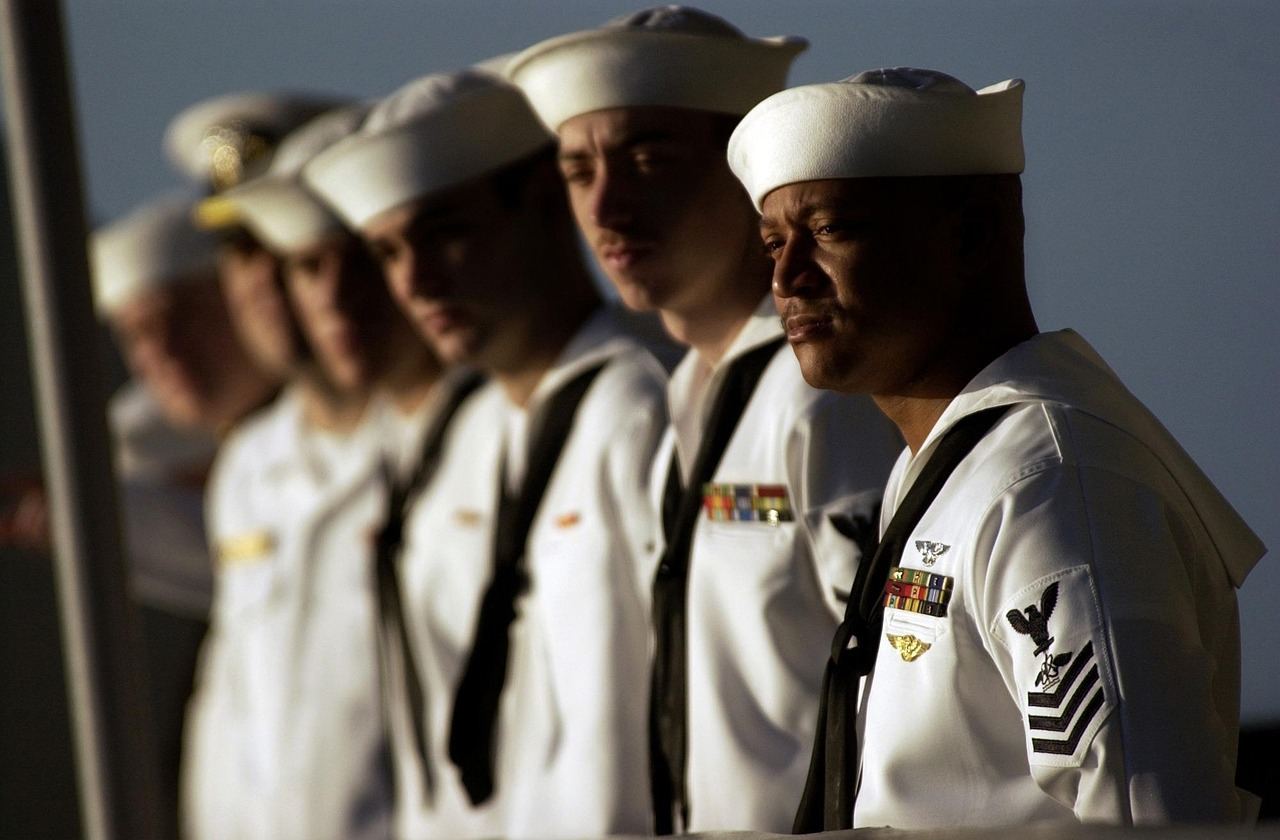
The U.S. Coast Guard normally falls under the Department of Homeland Security rather than the Department of Defense. It uses the same names for enlisted ranks as the Navy.
Rank describes a place in the chain of authority. For a different kind of recognition, read the medal of honor history guide.
Where officers fit
Officers make up the remaining 18% of the Armed Forces, and enlisted personnel rank below all of them. The 82% enlisted figure also counts military service academy cadets and midshipmen.
The primer behind this guide covers the enlisted force in detail, so this page does not list individual officer grades. For those, check the insignia pages of the service in question rather than relying on a secondhand chart.
Frequently asked questions
What is the difference between rank and pay grade?
Show answer
Pay grade is an administrative classification that determines certain rates of pay, such as E-6. Rank strictly means the order of precedence, though people often use the word as a synonym for grade.
Which pay grades count as junior enlisted?
Show answer
Pay grades E-1 to E-4. Members usually serve in them during a first enlistment term, normally four years.
Can an enlisted member outrank an officer?
Show answer
No. Enlisted personnel rank below all officers, according to the Congressional Research Service primer.
Does the Coast Guard use different enlisted rank names?
Show answer
No. It uses the same names for enlisted ranks as the Navy, even though it normally falls under the Department of Homeland Security.