
Struggling to follow the Declaration’s old-fashioned wording? This declaration of independence summary gives you the answer in plain terms: it explained why thirteen colonies were breaking from Britain, and what rights a government must protect.
If you want the wider story, start with the us history section.
| Item | Value |
|---|---|
| Adopted by the Continental Congress | July 4, 1776 |
| Independence section of the Lee Resolution adopted | July 2 |
| Drafting committee size | Five members |
| Writing delegated to | Thomas Jefferson |
| Signing of the parchment copy began | August 2, 1776 |
| Delegates who eventually signed | 56 delegates |
These figures come from the National Archives milestone page. Archive pages get revised, so check the source before you rely on them.
What the Declaration says, step by step
The Declaration is one long argument. It explains why it exists, states what it believes about government, lists the reasons for breaking away, and ends by accepting the split. The National Archives transcription keeps the original spelling and punctuation, which is why you see words like “shewn” and “Brittish”.
- Explain yourself. When one people must cut its political ties with another, “a decent respect to the opinions of mankind” requires it to give its reasons.
- State the principles. People have rights, governments exist to protect them, and a government that destroys those ends can be changed or ended by the people.
- Prove the case. The document lists “Facts” against the King of Great Britain, to be “submitted to a candid world”.
- Show patience. The colonists say they petitioned humbly and also appealed to their British brethren, without success.
- Accept the separation. Since nobody listened, the document says they must accept the break and treat the British as they treat the rest of mankind.
That last step is worth reading closely. The text says they will hold the British “Enemies in War, in Peace Friends”.
What do the “self-evident truths” mean?
The most quoted lines are the famous opening statement of principles. The document calls its main ideas self-evident, meaning it treats them as starting points that need no proof.
- Equality and rights: “all men are created equal” and are “endowed by their Creator with certain unalienable Rights”, which means rights that cannot be taken away.
- Named examples: “among these are Life, Liberty and the pursuit of Happiness”. The word “among” signals that this is a sample, not a complete list.
- Purpose of government: “to secure these rights, Governments are instituted among Men”.
- Source of power: governments derive “their just powers from the consent of the governed”.
- Right to change it: when a government becomes destructive of these ends, “it is the Right of the People to alter or to abolish it”.
The authors also add a warning against rash action. They write that governments “long established should not be changed for light and transient causes”, and that people tend to put up with evils while those evils are bearable.
The turning point is the phrase “a long train of abuses and usurpations”. When that pattern points toward “absolute Despotism”, the text says, “it is their right, it is their duty, to throw off such Government”.
The complaints against the king
The longest section is a charge sheet. It opens by calling the king’s record “a history of repeated injuries and usurpations”, all aimed at “an absolute Tyranny over these States”. Here are some of the charges, in plain language.
- Blocking laws: “He has refused his Assent to Laws, the most wholesome and necessary for the public good.”
- Shutting down assemblies: he “has dissolved Representative Houses repeatedly” for opposing his invasions on the rights of the people.
- Controlling judges: he “has made Judges dependent on his Will alone” for their offices and salaries.
- Armies in peacetime: he “has kept among us, in times of peace, Standing Armies without the Consent of our legislatures”, and the text also objects to “Quartering large bodies of armed troops among us”.
- Trade and taxes: the text objects to “cutting off our Trade with all parts of the world” and to “imposing Taxes on us without our Consent”.
- Trials: it objects to “depriving us in many cases, of the benefits of Trial by Jury”.
- War: he “has plundered our seas, ravaged our Coasts, burnt our towns, and destroyed the lives of our people”, and is bringing “foreign Mercenaries”.
Notice the repeated phrase “without our Consent”. It ties the complaints back to the earlier principle that legitimate power rests on the consent of the governed.
One charge uses the phrase “merciless Indian Savages”. Modern readers will see this as hostile and prejudiced toward Native Americans, and it is a reminder that the document reflects the views and blind spots of its time.
The complaints end with the colonists’ claim that they tried to settle things peacefully: “Our repeated Petitions have been answered only by repeated injury.” From that, the text concludes that a prince marked by such acts “is unfit to be the ruler of a free people”.
How the Declaration was written, adopted and signed
The path from idea to signed parchment took weeks, and the dates are often muddled. According to the National Archives milestone page, the sequence ran like this.
- June 10: Congress appointed a committee of five to draft a statement of independence. It included Thomas Jefferson, John Adams, Benjamin Franklin, Robert R. Livingston and Roger Sherman, with the actual writing delegated to Jefferson.
- June 11 to 28: Jefferson drafted the statement, then submitted drafts to Adams and Franklin, who made some changes.
- July 2: Congress adopted the section of the Lee Resolution dealing with independence, and then received the draft.
- July 3 and 4: Congress revised the text, which took all of July 3 and most of July 4. It adopted the Declaration on the afternoon of July 4.
- July 5: The approved text was printed, with only the names of John Hancock as President and Charles Thomson as secretary, and sent to state assemblies, committees of safety and commanding officers of the Continental troops.
- July 19: Congress ordered a parchment copy under a new title, “the unanimous declaration of the thirteen united states of America”, to be signed by every member.
- August 2: John Hancock signed the engrossed copy first, and other delegates followed.
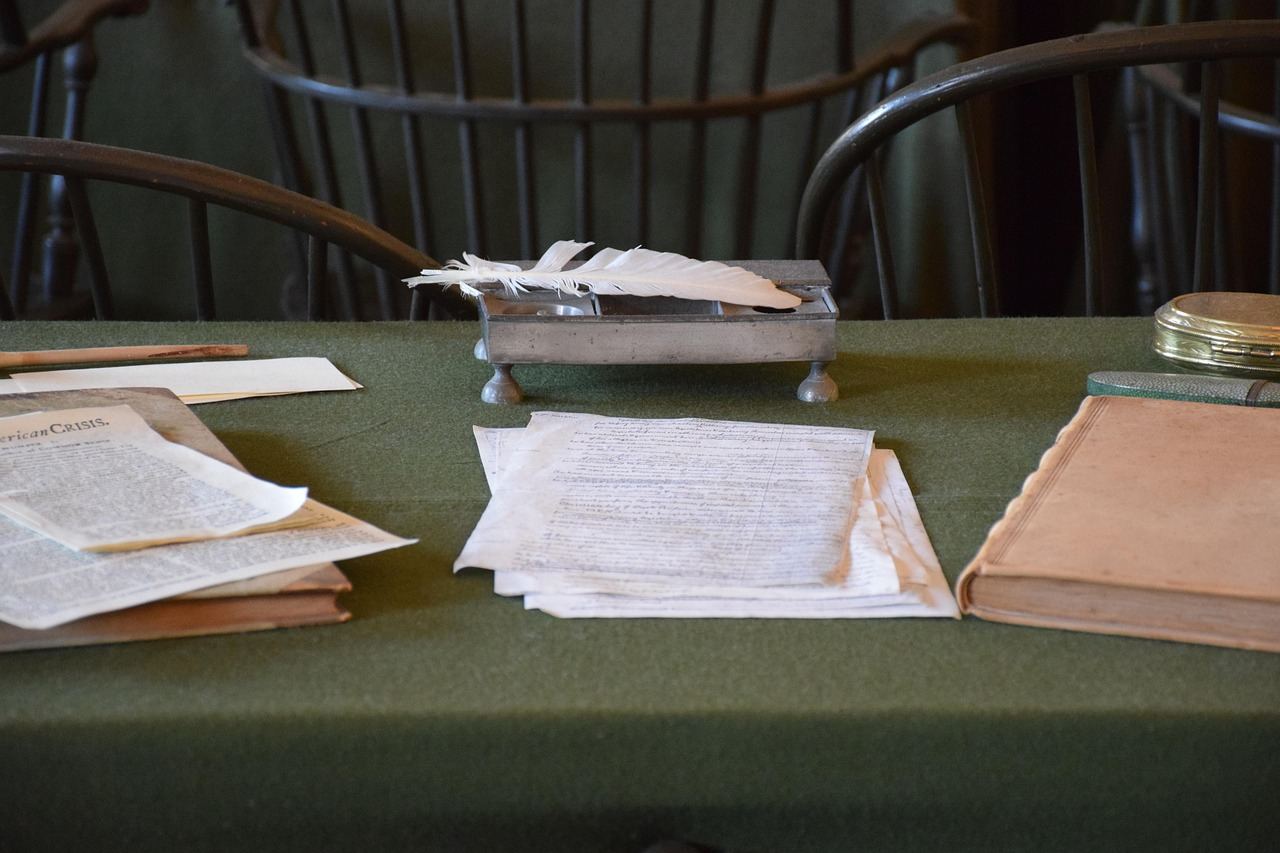
“Engrossing” simply means copying an official document in a large hand. The archives say the engrosser was probably Timothy Matlock, an assistant to Charles Thomson.
Not everyone was in the room on August 2, so signing stretched out. In the end, 56 delegates signed. Late signers included Elbridge Gerry, Oliver Wolcott, Lewis Morris, Thomas McKean and Matthew Thornton. Robert R. Livingston, a member of the drafting committee, never signed.
Where the Declaration fits in the bigger story
The Declaration is a statement of reasons and principles, not a set of working rules. To see where it sits among the events around it, read the american revolution timeline.
Its ideas about consent and rights also help explain later debates over how to build a government. For the framework that followed, see the us constitution explained guide.
A good way to read the original is to take it in the same order as the summary above. Start with the opening reasons, then the principles, then the grievances, and finish with the closing separation.
Frequently asked questions
When was the Declaration of Independence adopted?
Show answer
The Continental Congress adopted it on July 4, 1776, according to the National Archives. The independence section of the Lee Resolution had been adopted earlier, on July 2, and signing of the parchment copy began on August 2.
Who wrote the Declaration of Independence?
Show answer
Congress appointed a committee of five, and the actual writing was delegated to Thomas Jefferson, per the National Archives. Adams and Franklin reviewed his draft and made some changes, and Congress then revised it further.
How many people signed it?
Show answer
The National Archives says 56 delegates eventually signed. Some delegates never signed, including Robert R. Livingston of New York, who served on the drafting committee.
What is the main idea in one sentence?
Show answer
The main idea is that governments get their just powers from the consent of the governed, and that people may change or abolish a government that destroys their rights. The Declaration then argues that the King’s actions had reached that point, as the National Archives transcription shows.